
Welcome to 2026
Happy new year or no...?

Dear reader,
I hope that this ‘Happy’ New Year of 2026 is treating you well so far.
Here in Melbourne we have just passed the third Friday in January; the second Friday is known (apparently) as Quitter’s Day, whereby the majority of us give up on our New Year’s Resolutions.
Interestingly, the etymological ancestor of the word ‘resolution’ meant to reduce or break things down into a simpler form. It was by the 15th century that it came to mean a pledge to do something. Perhaps reducing aspirations into the distilled and simpler form of a resolution is a way of breaking down a gnarly life-goal into an achievable undertaking, and it is this that led to the shift in meaning and usage in the word ‘resolution’?
I don’t make resolutions any more. For myself, I have found my life to be too peripatetic to support the making and keeping of year-long promises. Typically, events overtake me and I have to focus on coping; carefully crafted promises-to-self and their regimens are soon forgotten.
I hope you are having a happy new year but wouldn’t be surprised to find that you are not, or, if you are, that your happiness is tempered with anxiety or frustration as Donald Trump or climate change or [insert villain / phenomenon of choice] has its wicked way with the world.
The adjective ‘happy’ comes from the noun ‘hap’, which means chance, fate, or luck. And I guess that the bizarre state of the world right now - the daily cavalcade of dire headlines we see in the news - might make many of us feel as if we are creatures of fate. Wherever you are and whatever you’re dealing with, I hope you’re at least coping.
Now for a creative prompt:
I chose this prompt because I was musing on how we have just all been through the festive season, and how some of us may still be on holidays and some just beginning their new work year. Some of us will be at play and some of us will be wishing we were.
And the notion of play also often links to ideas of childhood and happiness – perhaps conjuring up notions of innocence or perhaps of disinhibition. Either way, a time of less complexity, nervousness, or pressure than many of us are experiencing right now.
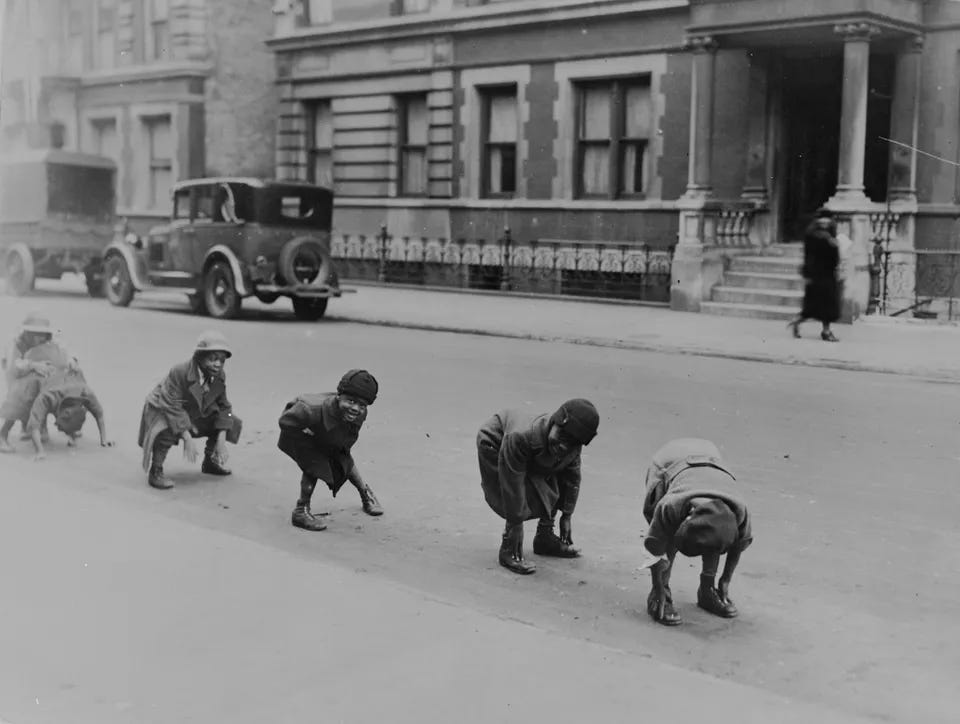
So today I thought it would be interesting to ask you to respond to this quotation:
“It's never too late to have a happy childhood.” Tom Robbins
You can think / imagine / write / paint / perform / design whatever you like, but here are some optional questions to get you going:
What feelings, memories, or thoughts do these words elicit for you? Happy or unhappy (we all had different childhood experiences)?
Do you agree with Robbins?
Describe a happy childhood from a kid’s perspective.
If you are reclaiming your right to have a happy childhood, describe it from your adult perspective.
If you could do anything - anything at all - what would you want to play with today?
Thanks for reading.
I am in the process of reviewing my Substack posts and trying to formulate a direction for this Substack overall. This post was inspired by a creative prompt I shared with paid subscribers back in 2022, shortly after the birth of this Substack in late 2021.
Since then I have shared reflective prompts, personal musings, favourite quotations and poetry, etymological tidbits, and more creative prompts, always featuring images from my beloved trove of Public Domain pictures.
Please feel free to share with me what you want to see more of in this Substack so that I get some idea as to how to create, curate, and tailor content that really connects with you readers. Because that connection has meant so much to me over the last few difficult years.
What do you want?
The etymological connection between resolution and reduction you've uncovered here is absolutely brillant work. Your insight about breaking down aspirations connects to something most people dunno, which is that our linguistic history often holds practical wisdom we've forgoten over time. I've found similar patterns in my own word origin research where ancient meanings actually solve modern problems more effectively than contemporary usage. This piece reframes New Year's promises from inevitable failure into a process of iterative refinement.